
I Tried the Viral Fruit-Layer Bottle Terrarium — Here's Why Mine Turned Into a Swamp
I saw the video at midnight and had an empty glass bottle on the counter by breakfast. The pitch was irresistible: a closed bottle terrarium that mostly takes care of itself, with a layer of fruit at the bottom to feed the plants so you never have to fertilize. I was sold. I layered in orange peels, a few apple slices, some soil, and a little fern, sealed it up, and waited for my self-sustaining jungle to appear.
What appeared, three weeks later, was a foggy bottle that smelled like a compost bin in July, with fruit flies circling the cork and a slick of gray fuzz spreading across the glass. The viral method had failed me, and it took me a while to understand why the idea sounded so good and went so wrong.
Why This Happens
Fruit is food, for you and for microbes. In an open compost pile, that is exactly what you want: the fruit breaks down, and the nutrients feed your garden. But a sealed bottle terrarium is not a compost pile. It is a closed loop with no drainage, no airflow, and nowhere for the byproducts of decomposition to go. When you bury fruit in there, you are not feeding your plants. You are staging a slow, humid rot.
As the fruit decays, it releases moisture, sugars, and gases into a space that cannot vent. The humidity spikes, the substrate turns sour, and the sugars feed mold and bacteria instead of your ferns. That is exactly the fuzzy gray film and the swamp smell I ended up with. The plants in a closed bottle get their nutrients from the soil and from the light they capture, not from a rotting apple in the basement of the jar.
There is also a simple physics problem. A genuinely self-sustaining closed terrarium runs on a water cycle: moisture evaporates, condenses on the glass, and drips back down. When you add a wet layer of fruit, you flood that cycle from the bottom up. The result is not an ecosystem. It is a sealed, rotting sponge, and the plants slowly drown in it.
What I Tried First — and Why It Didn't Work
My first fix was to open the bottle, dump out the fruit, and leave everything else in place. That helped for about four days, and then it did not, because the fruit residue had already soaked into the soil and the whole substrate was sour. The smell came back, the mold found the new damp spots, and I was back to square one with a messier bottle.
Then I overcorrected and dried the terrarium out completely. I left the cork off for a week, convinced airflow would fix it. It killed the mold, sure, but it also crisped the fern and shrank the moss to brown threads. A bottle terrarium lives or dies on stable humidity; yanking it open just traded one problem for another.
My third attempt was to add a little activated charcoal on top of the soil, hoping it would absorb the smell and save the design. Charcoal does help filter a terrarium, but it is a support player, not a rescue crew. It could not undo a rotting fruit layer sitting under everything, and I finally admitted the whole foundation was wrong and rebuilt from scratch.
What Actually Worked
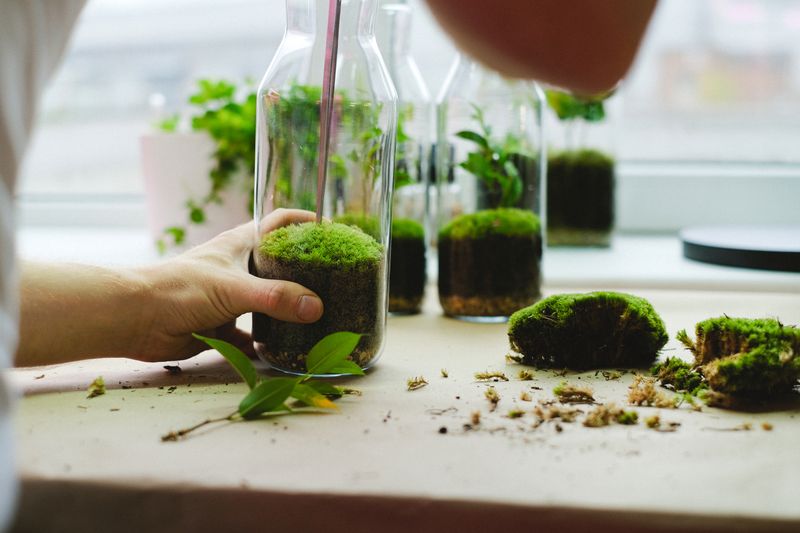
I started over with an actual closed-bottle build, which means layering in the order the glass demands. Bottom to top: a generous drainage layer of pebbles or leca for the water to sit in, a thin barrier to keep soil out of it, then a soil mix blended for terrariums, then moss and small plants on top. No fruit, no compost, no "nutrient layer." The drainage zone is where excess water goes, and it is the single thing the viral version skipped.
This is where a proper closed-terrarium kit makes the whole difference. The good ones hand you the exact layers, from the pebbles to the charcoal to the soil and moss, so you are not improvising a foundation out of kitchen scraps. When the layering is right, the bottle stops swinging between swampy and parched and settles into the light, even fog on the glass that tells you the water cycle is working.
For the plants themselves, I chose slow, humidity-loving species, a small fern, some cushion moss, a tiny creeping fig. Because they tolerate the sealed, damp conditions a bottle creates. I misted lightly before sealing, not soaked, and then I sealed it and left it alone. For the first month that took real restraint, because every instinct said to open the lid and fiddle.
The last piece was placement. I put the bottle somewhere bright but out of direct sun, since a sealed container in hot sunlight turns into an oven and cooks the plants. With steady indirect light and the right layers, condensation stays light, the moss stays green, and the bottle essentially runs itself. I open it maybe once a month, and only if the glass looks too wet.
Terrarium Kit with Live Moss & Springtails
Includes the drainage pebbles, charcoal, soil blend, and moss you need to layer a bottle right the first time.
Check price on AmazonGlass Terrarium with Drainage Layer
Curved tweezers and a slim spoon let you plant and tidy a narrow bottle mouth without wrecking the layers.
Check price on AmazonWhat I'd Tell Someone Starting Today
Skip the fruit. I know it looks clever, and I know the video made it seem foolproof, but a sealed bottle has no way to handle rotting produce. Put your energy into the layers instead. Drainage, barrier, soil, moss (because that is what actually decides whether your terrarium thrives or turns into a science experiment you have to discreetly throw away.)
Pick thirsty, slow-growing plants, seal it, and then leave it alone more than feels natural. My second attempt is now eight months old, the fog on the glass is light and even, and nothing in it smells like anything at all. That lack of a smell is the whole win.
This post may contain affiliate links. If you buy through one of them, we earn a small commission at no extra cost to you.