
My Puppy Wouldn't Sleep Through the Night — The White Noise Setup That Finally Worked
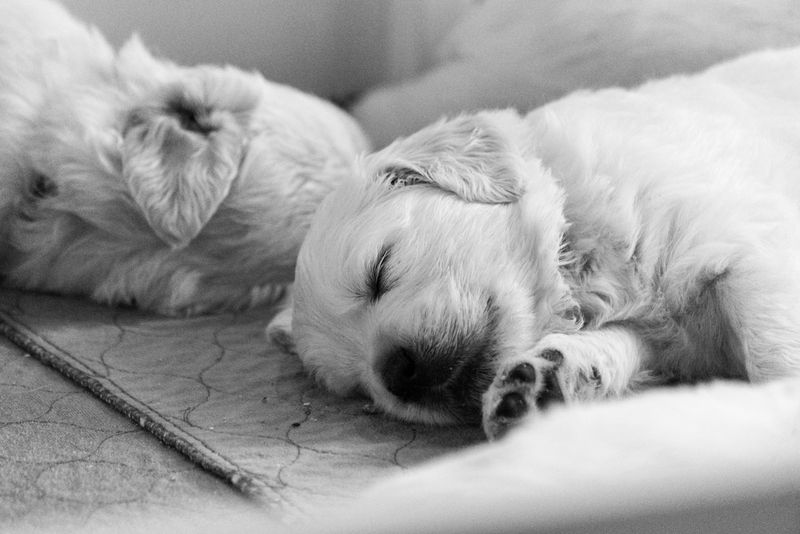
At 2:47 a.m. On a Tuesday, the crying started again. Not the sharp yelp of a puppy who needed to go out, but the long, rising monotone of a nine-week-old who was wide awake and convinced she was alone. I was lying on a mattress on the floor with my hand dangling into her crate, four feet from a box fan I'd dragged in from the closet, and it still wasn't enough. The refrigerator twenty feet away switched on with a click, and she startled all over again.
The first week I thought we'd hit the jackpot. She slept two solid hours that first night because she was exhausted from the car ride home. Every night after that got worse. Ninety minutes of sleep, then awake and crying. I tried getting up, I tried ignoring it, I tried lying with her. By day six I was averaging four broken hours a night. The problem wasn't that she couldn't sleep. It was that every small sound in an apartment building woke her back up.
Why This Happens
Puppies don't arrive able to sleep through the night any more than they arrive house-trained. Their sleep cycles are shorter than an adult dog's, their bladders are tiny, and, this is the part I didn't appreciate until later, their hearing is dramatically more sensitive than ours. A dog's hearing reaches into frequencies humans can't perceive, and the ordinary sounds of a home at night that fade into our background are distinct, repeated events to a puppy.
On top of that, a puppy has just been separated from its mother and littermates, often for the first time in its life. For eight weeks it slept in a warm pile of siblings where any movement meant company. Now it sleeps alone, and an unfamiliar noise at 3 a.m. Signals nothing reassuring. The crying isn't manipulation. It's a genuinely stressed animal asking whether the group is still there.
This is where white noise actually helps. It doesn't magically make a puppy sleepy. What it does is even out the sound floor, it replaces a series of sudden, separate noises with one continuous, unchanging wash. The refrigerator click, the neighbor's footsteps, the elevator, the car door in the parking lot: all of them either disappear into the hiss or become such a small change that they stop registering as events. For a puppy wired to react to novelty, removing the "events" removes most of the reasons to wake.
What I Tried First — and Why It Didn't Work
My first attempt was the box fan. It's free, it's loud, and everyone on the internet recommends it. It half-worked, the noise was right, but the fan was in the wrong place and the wrong machine. Putting it in the doorway meant the sound came from one direction and dropped off across the room, so wherever the puppy was, the masking was uneven. And a box fan hums in a narrow band that didn't cover the sharp, high clicks that woke her.
Next I borrowed a cheap sound machine designed for babies. This was worse in a sneaky way. It shipped with tracks (rain, ocean, a lullaby melody, and the rain track had a thunderclap every ninety seconds. Guess what happened every ninety seconds. Every track had a pattern, and patterns are exactly what a puppy's brain notices in a quiet room. I also made the classic mistake of setting it on a sleep timer, so an hour after she fell asleep the room went silent and every sound snapped back into focus.)
Third, I tried the "tire them out" theory. I walked her, played fetch in the hallway, did a training session right before bed. She slept well for half the night, then woke at 2 a.m. Completely wired, an overtired puppy is a wired puppy, the same way a toddler who skips a nap melts down at dinner. Exhaustion buys a second wind, not sleep.
What Actually Worked
The fix that finally worked was a single continuous white noise source, not a patterned sound machine, and the difference mattered more than the brand. I picked a machine whose "white noise" setting is a genuine broadband wash, closer to the shush of a rushing fan than to rain, and I ran it all night, every night, no timer. Boring and constant beat pretty and variable, every time.
Placement was the second half. I set the machine on the floor behind the crate, between the crate and the wall, so the sound reached her from a neutral, hard-to-locate direction rather than blasting from my side of the room. I checked the level with a free decibel app on my phone and aimed for roughly fifty decibels at her head. Loud enough to bury the refrigerator, quiet enough that I could still sleep. You don't need it loud. You need it continuous and even.
Then I turned it into a routine instead of just a noise. Every nap and every bedtime, the white noise went on first, then I'd cue her onto her mat and reward the exact moment her body softened. The trick at night was using a treat that didn't require chewing, because a dry crunch is its own wake-up event. I used Buddy Biscuits Trainers Training Bites. The soft, chewy bacon ones (and pressed one tiny piece against her nose the second she relaxed. The sound and the calm got paired in her head: white noise means the good, quiet thing happens, so stop scanning the room. On the rougher nights when she needed a longer settle, I switched to Jiminy's Soft & Chewy Dog Training Treats, the sweet potato and pea recipe, which she'll work at a little longer without getting up.)
The last piece was consistency, and this is where most people, including me. Undo their own progress. I stopped changing the sound. No rotating tracks, no different machine at grandma's house, no silence on the weekends. The power of white noise is that it's the one thing in the room that never changes; mess with it and you've reintroduced the novelty you were trying to remove. It took about two and a half weeks before she slept through, and the nights that failed were the nights I'd changed something.
What I'd Tell Someone Starting Today
Buy the machine before the puppy comes home if you can, pick one continuous sound, and start it on day one. First naps included, so the noise becomes a normal part of the day rather than a nighttime signal. Run it all night at a level you verify with a phone app, and put it where the sound reaches the crate evenly. Then don't touch it. Same sound, same spot, same routine, for a few weeks.
One caveat worth saying plainly: white noise helps a puppy that's overreacting to sound, but it won't fix a puppy that genuinely needs to go out or isn't feeling well. If a young puppy cries hard and won't settle after fifteen minutes, take it to the potty spot and back, and rule out anything medical with your vet before you decide it's a behavior problem. Once I had the noise right, though, the 2:47 a.m. Crying stopped being a nightly event and turned into an occasional one, and then just stopped. I've slept since. You will too.
This post may contain affiliate links. If you buy through one of them, we earn a small commission at no extra cost to you.