
My Cat Spent Every Day Chattering at Birds Through the Glass. Here's How I Finally Took Her Outside Safely
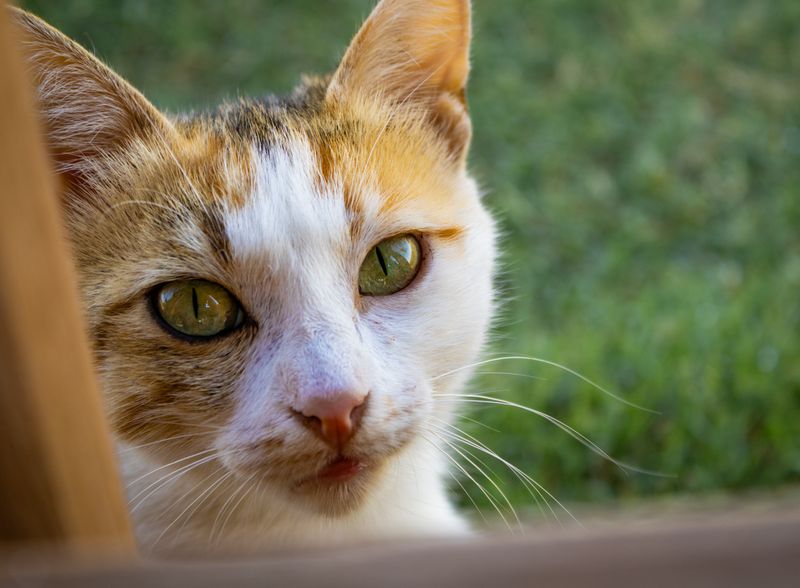
Every morning at 6:40, before I had even started the coffee, my cat Juniper was already at the bay window doing the thing — the silent, jaw-quivering chatter cats make when they have locked onto a bird. She would track sparrows along the hedge, follow a crow with just her head, and flatten her ears the second a squirrel crossed the lawn. Then she would look back at me with a flat, fed-up expression, like I had put the glass there on purpose.
For a while it was funny. Then it stopped being funny. By spring she was yowling at the window every afternoon, pawing the pane hard enough to leave smudges, and sprinting to body-check the sliding door every time something moved outside. She slept more and played less. The vet found nothing wrong. She was not sick — she was bored in the specific, gutting way an indoor cat gets when the whole living world sits a few inches away, on the wrong side of glass she can smell through but never cross.
Why This Happens
Cats are ambush predators, and their whole nervous system is tuned to notice small, fast, twitchy things. A window full of birds is a slot machine for that instinct: the bell keeps ringing, but the prize never drops. Trainers call it "watching without hunting," and that mismatch is exactly what drives the frustration. Her brain floods with prey drive every day and gets no outlet for any of it, so the energy spills outward instead.
The instinct is not something you can or should switch off. Blocking her view of the yard would not calm her down; it would just make the boredom worse. And there is a reason safe access beats unsupervised access: indoor cats live measurably longer than outdoor cats, and the reason is cars, dogs, parasites, and other cats. So the goal was never to turn Juniper loose on the neighborhood. It was controlled outdoor access — the smells, the sounds, and yes, the birds — without any of the ways an outdoor cat dies young.
A cat who spends her days over-aroused and under-stimulated also carries a higher baseline of stress, and stress is not abstract in cats. It shows up as litter box avoidance, over-grooming, even squabbles with the other cat. When I started treating the window obsession as a symptom of an unmet need instead of a cute quirk, the whole plan changed.
What I Tried First — and Why It Didn't Work
My first bright idea was to crack the window and let her sniff through the screen. She loved it for two days, and then she found the one loose corner and started working it with both front paws. A cat who wants outside will absolutely remodel a screen to get there, and a second-floor drop is not a lesson you want to teach. That experiment ended the same afternoon.
Next I tried a harness and leash, walking her like a dog. If your cat takes to a harness on the first try, you have a unicorn. Juniper pancaked flat onto the sidewalk, refused to move, then slipped her shoulders free of the whole thing and rabbit-punched back under a parked car. I stood in the street for twenty minutes coaxing her out.
The third thing was more toys — a wand, a laser, a little robotic mouse. Every one helped for exactly as long as I was holding it. The birds across the glass never clock out. No toy was going to out-compete something that moved on its own and smelled real.
What Actually Worked
The breakthrough was embarrassingly simple: I stopped trying to keep her away from the outside and gave her a contained way to actually be there. I picked up a MoNiBloom Pet Stroller and started taking her on a slow loop around the block every evening. The mesh sides let her watch everything — birds, dogs, leaves, people — while she stayed fully zipped in, and the canopy kept her shaded so she never overheated. The first time a robin hopped past three feet away and she just watched it, ears up and calm instead of pinned flat, I knew it was working. She now gets a twenty-minute ride most evenings and is flat asleep by the time we get home.
The stroller solved "I want to be out there," but I still wanted her to have a spot where she could stand on real ground with the wind in her fur. So I set up an FXW Rollick Dog Playpen on the patio. It is a folding exercise pen — eight welded-wire panels, twenty-four inches tall, no tools — so I can pop it up in about a minute and fold it flat against the wall. I put her inside with a water bowl and a scratching pad, sat down next to her, and let her simply exist outside for an hour. She rolled in the sun and pounced a passing moth with her whole body, which I had not seen her do in a year.
The pen also solved my safety worry, which had been the real obstacle. Because the panels are see-through, she never gets the trapped, panicky feeling she gets in a carrier, but the spacing is tight enough that a cat cannot squeeze out. I anchored it in the shade, checked it never sat in direct sun long enough to cook, and never left her unattended in it. It is supervised outside time, full stop — but supervised outside time turned out to be exactly what she was missing.
Stacking the two gave her options: a stroller for moving through the world, a pen for standing still in it. Added to her old window, her whole day changed shape. The yowling stopped within a couple of weeks, and so did the late-night ankle attacks.
What I'd Tell Someone Starting Today
If you are going to try this, do not start with the harness. It is the most common first move and the one that fails most often, and a single bad harness experience can sour a cat on the outdoors for good. Start with a stroller, because it is a space she can feel safe inside from the first minute — no escape risk, no training, no stress for either of you. Once she is genuinely relaxed riding in it, graduate to a supervised pen somewhere familiar, like a patio or balcony.
Keep every session short and supervised. Always provide shade and water. Never leave her alone outside, even inside a pen. And keep the window open to her, too — the whole point was never to take the view away, just to let her finally participate in it. Juniper still chatters at the sparrows. She just is not pressing her whole body against the glass to do it anymore.
This post may contain affiliate links. If you buy through one of them, we earn a small commission at no extra cost to you.