
She'd Stopped Chasing the Wand. The Automatic Feeder Gave My Cat Something to Do Again.
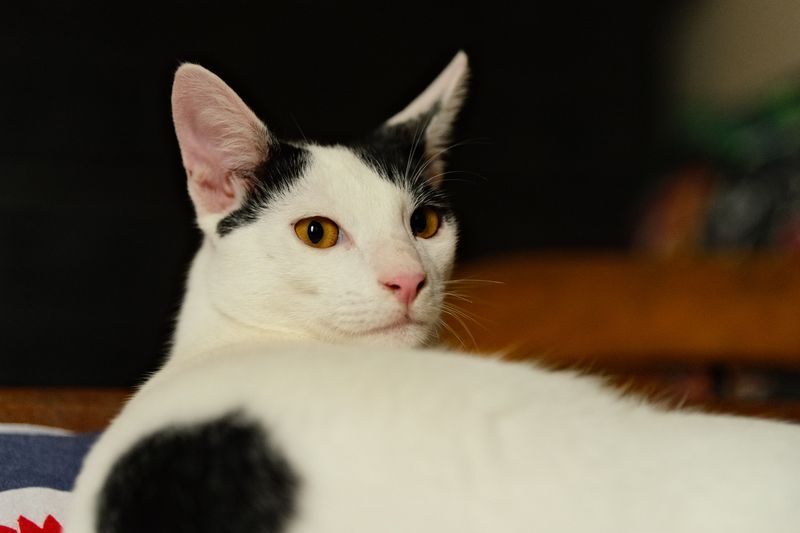
For four years, Poppy was the kind of cat who would leap two feet straight up to catch a wand toy. Then, sometime around her sixth birthday, she stopped. I would pull out the feather wand and she would watch it from the couch with the flat, bored expression of someone who had seen this movie before. She slept more, ate the same amount, and got a little softer around the middle. Nothing was wrong, exactly. She was just done.
I know how that sounds — a cat being lazy is not a crisis. But Poppy's whole personality had dimmed. She used to patrol the apartment every evening. Now she would wake, eat, and go back to sleep in a patch of sun. It took me a few months to connect the dots, but the change lined up with one thing: a bowl of food sitting on the floor, always full, that never asked anything of her.
Why This Happens
Cats are built to hunt, and hunting is a job, not a hobby. In the wild, a cat's day is a long series of small, quiet, effortful events — stalk, pounce, eat, rest — and that cycle is a big part of what keeps a cat's brain and body engaged. An indoor cat with a full food bowl has had the entire job removed. The eating remains; everything that made eating interesting is gone.
That is when boredom sets in, and boredom in cats looks exactly like what Poppy was doing: sleeping more, playing less, gaining a little weight, losing interest in the toys that used to light her up. It compounds, too. A slightly heavier cat is a slightly slower cat, so play is harder and less rewarding, so she plays less, so she moves less. It slides quietly in one direction unless something interrupts it.
There is a feline-clock reason free-feeding flattens a cat's day, as well. Cats are crepuscular — most active at dawn and dusk — and their natural pattern is several small meals tied to hunts, not one endless buffet. When food is always available, there is no hunt to anticipate, no reward to earn, no reason to be up and moving at six in the evening. You have not made her life easy. You have made it empty. And the fix is not to play harder; it is to put the job back.
What I Tried First — and Why It Didn't Work
My first move was to buy new toys. I went through four wands — a moth, a bird, a long ribbon, a realistic feather — and each one earned maybe a day of genuine interest before she filed it under seen it. Novelty wears off fast for a cat, and rotating the same dozen toys I already owned did not help either, because she knew them all.
Next I tried the laser pointer, which she loved for exactly two evenings and then ignored. In hindsight I know why: a laser is pure chasing with no catch, ever. A cat can never win, and for some cats that is not just boring, it is actively frustrating.
Then I tried to out-play her — long, determined sessions where I was more energetic than she was — and she would simply stand up and leave the room mid-game. I leaned on catnip, which worked for about ten minutes before she was asleep. Every one of these fixes attacked the symptom, not the flat, empty shape of her days.
What Actually Worked
The change that worked was making her work for food again — turning meals into puzzles. I started with the AWOOF Pet Snuffle Mat, which was exactly what Poppy needed. You scatter kibble into the deep fabric folds and the cat has to root through them with her nose and paws to find each piece. The first time I set it down, she worked it for twenty minutes straight, and I watched her body language come back to life: ears forward, tail flicking, completely absorbed. That is the old hunting circuit running again.
A snuffle mat is great because it is portable and works for a cat as easily as for a dog. But the mat alone still means food shows up whenever I decide. The bigger open up was an automatic feeder that drops small, timed portions several times a day. Now Poppy's meals arrive tied to the clock, in small amounts, and she has to be awake and alert to get them. Five small meals spread across dawn and dusk turned her whole daily rhythm back on. She waits by the feeder in the evening the way she used to wait by the wand.
I rearranged how I feed her, too. Big bowl, gone. It is the automatic feeder for most of her daily ration now, with the snuffle mat a couple of times a week so the work stays interesting. I moved one feeder to a different room so she has to walk to it. Small distances, but they add up to a cat who moves instead of naps.
The last piece was a short, structured play session right before her final meal of the day — five minutes, a wand I keep in a drawer and do not leave out, ending with a real catch so the hunt has a finish. Pairing a hunt with a meal matters, because that is the natural sequence: catch, then eat. When she grabs the toy and then eats, the loop feels complete, and it holds her interest far better than a random toy dangled at noon.
Within about two weeks her energy was visibly different. She was patrolling again. She dropped a little of the soft weight. And she met me at the door in the evening, which she had not done in a year.
What I'd Tell Someone Starting Today
If your cat has gone flat, look at how she eats before you buy a single new toy. An always-full bowl quietly removes the point of her day. Get an automatic feeder so food arrives in small, timed portions, and add a puzzle feeder like a snuffle mat so at least some of those meals take effort to earn. Then do one short hunt-with-a-catch before dinner every day.
You are not going to out-wand a bored cat with more of the same toys; you are going to reinstall the structure her instincts run on. Poppy still naps the way cats nap. But she is busy again, and busy is what a cat is supposed to be.
This post may contain affiliate links. If you buy through one of them, we earn a small commission at no extra cost to you.