
She Wasn't Chasing the Wand Anymore. The Automatic Laser Gave Her Play Back.
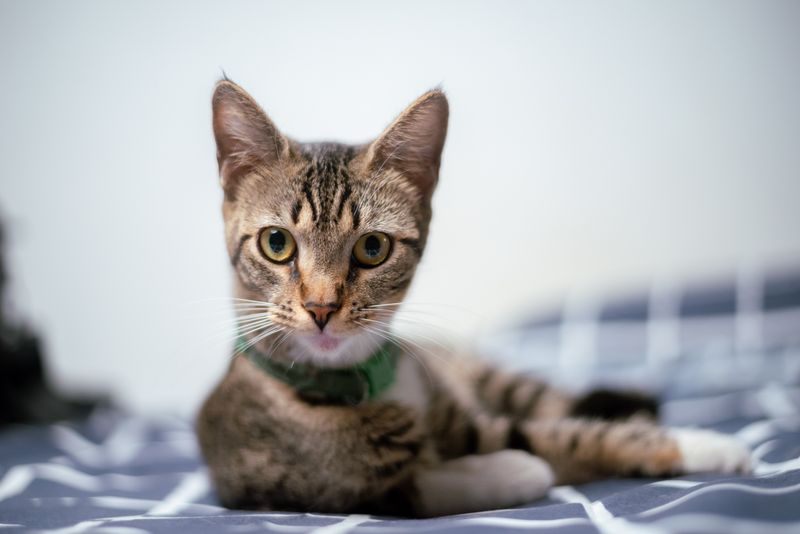
The wand toy used to be the best five minutes of Nala's day. She is three, a slim grey tabby, and for two years she would hear the drawer open and be across the room before I had even stood up. Then she stopped. I would wave the feather, she would track it with her eyes for a second, and then look away like the whole thing was beneath her. Same toy, same cat, suddenly nothing.
It is easy to wave this off as a cat being a cat. But Nala was not just unimpressed; she was under-stimulated, and it showed. She started sleeping through the evening, the time she used to spend hunting the apartment. She would stare at the wall. She knocked things off shelves for entertainment, and not the fun way — the bored way. My cat was not tired. She was looking for something to do, and I had stopped being enough of a hunting partner.
Why This Happens
Cats play because play is practice for hunting, and hunting runs on novelty, surprise, and the promise of a catch. The reason a wand works at all is that it imitates prey — quick, erratic, unpredictable. The reason it stops working is that the cat has learned your arm. After a few hundred sessions, a cat knows exactly how fast you move, where you stop, and what patterns you fall into. You have become predictable, and predictable prey is boring prey.
There is a math problem underneath the boredom, too. Indoor cats need a real daily outlet for hunting drives that would keep a wild cat busy all day. When that outlet thins out — because you are busy, because work ran late, because you are tired — a cat does not reduce her needs; she just gets them nowhere. The drive does not disappear. It turns into wall-staring, shelf-knocking, and sleeping through the hours she should be most alive.
Then there is the trap of the plain laser pointer. It seems like the perfect toy — endless fast movement, no arm fatigue — but a laser with no reward at the end can quietly backfire. A cat chases with her whole body and never catches anything, never gets the satisfaction that closes the loop. For some cats that is mild frustration; for others it builds genuine tension. The lesson is not that lasers are bad. It is that play has to end in a catch, or it is not really play.
What I Tried First — and Why It Didn't Work
My first move was buying new wands. I cycled through four of them — a bird, a bug, a long ribbon, a crinkle snake — and each one was interesting for about a day before Nala filed it away. New props, same predictable operator. She had figured me out.
Next I went full laser pointer, waving the dot all over the apartment, and she loved it for two nights before going flat. Looking back, I understand it: chase, chase, chase, catch nothing, every single time. No wonder she quit. I had built her a game with no win condition.
Then I tried to brute-force her interest — longer sessions where I kept waving the wand even after she had disengaged, trying to re-spark her with sheer enthusiasm. That just taught her to leave the room when the drawer opened. I also dumped a pile of catnip toys on the floor, and they bought me one energetic evening and then nothing. Every attempt was more of the same stimulus, only louder.
What Actually Worked
The thing that worked was giving her play that did not depend on me being in the mood or in the room: an automatic laser toy that moves the beam around on its own, on a timer, with a random enough pattern that she cannot predict it. The randomness is the point. Nala cannot learn its arm the way she learned mine, so the chase keeps feeling like chase. I switch it on for ten or fifteen minutes in the morning and again at dusk — her two natural active windows — and she gets a real hunt even on the days work swallows me whole.
The critical correction I made to my original laser mistake was to give the hunt a finish. An automatic laser that just stops is a game with no catch, so I always follow a laser session with the wand or a physical toy she can actually pounce on and grab. That closing catch seems to matter more than the chasing — it discharges the tension instead of building it. Once I added the finish, her interest in play came all the way back.
I also gave her something to do entirely on her own teeth and paws, with no electronics involved. The RYERCAT Silvervine Sticks are natural chew-and-bat toys, and silvervine is a plant many cats respond to even more strongly than catnip. I leave one out so Nala has an independent outlet: something to grab, kick, and chew whenever the mood hits, not just when I am available. It is the low-tech counterpart to the laser, a toy with a tangible thing in her claws instead of a light she can never touch.
The last change was a schedule. I gave Nala two real play blocks a day — one in the morning, one in the evening, the two times she is naturally wired to hunt — and I stopped leaving the wand out between sessions, which keeps it special. Then I rotate what I use so nothing gets learned into boredom.
What I'd Tell Someone Starting Today
If your cat has gone bored on wand toys, the answer is not a fancier wand — it is more play than you can personally deliver, with a catch at the end. Get an automatic laser toy that moves on its own and schedule it for dawn and dusk, then always finish with a physical toy she can grab. Add something like silvervine sticks so she has an outlet that does not need you at all.
And never let a laser be a game that never ends. Give her the catch, give her the routine, and she will meet you at the wand again. Nala went from staring at the wall to waiting by the toy drawer every evening. She was not done playing. She was done with predictable play.
This post may contain affiliate links. If you buy through one of them, we earn a small commission at no extra cost to you.